TikTok $400 Million Settlement on Children’s Privacy Case 2026
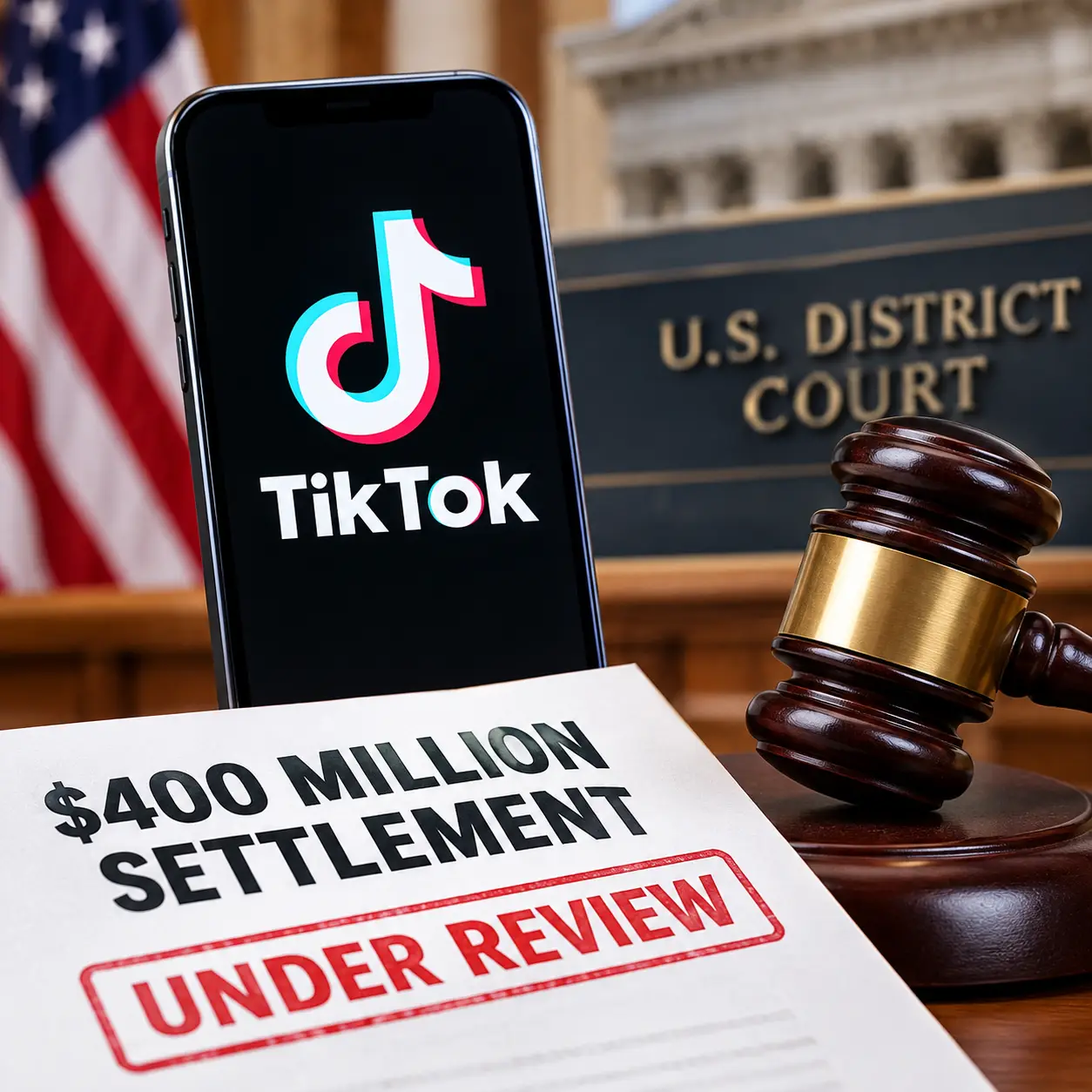
A federal judge has signaled he is inclined to refuse to lift a 2019 children’s privacy order tied to TikTok’s predecessor. That puts part of the TikTok $400 million settlement with the U.S. Justice Department in doubt. Judge George H. Wu of the U.S. District Court for the Central District of California issued the tentative ruling on Friday, September 18, 2026. Reuters reported it on September 19.
The key point: the court has not rejected the settlement. Nothing is final. A hearing is set for Monday, September 21, 2026, and the judge could still change course.
At issue is a $100 million payment that depends on ending the old order. Here is what is known, what is not, and what happens next. For more hot newses stay connected with the tiktok news site.
TikTok $400 Million Settlement Faces a New Problem
| Topic | Details |
|---|---|
| Company | TikTok / ByteDance |
| Issue | Children’s online privacy |
| Settlement | $400 million proposed settlement, announced August 21, 2026 |
| Government | U.S. Department of Justice, on FTC referral |
| Law involved | Children’s Online Privacy Protection Act (COPPA) |
| Court | U.S. District Court, Central District of California (Los Angeles) |
| Latest development | Judge Wu tentatively signaled he would deny the request to end the 2019 consent decree (Sept. 18; reported Sept. 19) |
| Next key date | Hearing, September 21, 2026 |
| Current status | Pending. The court has not issued a final ruling on the request to end the decree. |
Here is the short version. TikTok latest news and its parent, ByteDance, agreed in August to settle a 2024 Justice Department lawsuit. The government accused them of violating a federal law that requires parental consent before collecting personal information from children under 13.
One piece of the deal needs a judge’s approval. The agreement asks the court to end a 2019 consent decree, an order from an earlier case against Musical.ly, the app that became TikTok. Judge Wu said he was inclined to reject that request. Without more details, he said, he could not tell whether ending the order would be a “durable remedy.”
It matters because $100 million of the $400 million is tied to that request.
What Is TikTok $400 Million Settlement About?
The Justice Department announced the deal on August 21, 2026. It said TikTok, ByteDance and affiliated companies would resolve a case about compliance with the Children’s Online Privacy Protection Act. The department called it one of the largest recoveries ever in a case under that law.
| Part | Amount | Condition |
|---|---|---|
| Immediate payment | $300 million | Payable immediately under the settlement, per the DOJ |
| Additional payment | $100 million | Due only upon entry of an order vacating the 2019 Musical.ly consent decree |
| Total | $400 million | Proposed settlement |
Do not mix up the two pieces. The $300 million is described as payable now. The $100 million is the conditional part, and it is the part now in question. The DOJ also said the claims are allegations only and there has been no determination of liability.
Why Is the Judge Questioning Part of the Settlement?
A consent decree is a court order that both sides agreed to. It works like a set of rules a company must follow, with the court watching. To end one, the parties can ask the judge to vacate it. But the judge decides whether that is justified, even when nobody objects.
That is the issue here. According to Bloomberg reporting summarized by other outlets, Judge Wu said the government had not shown that TikTok’s ownership changes, its compliance measures or the settlement justified ending the order. One summary of the 16-page tentative ruling, from the trade site PPC Land, says the settlement terms were not filed with the court and that the request was unopposed.
What Is 2019 TikTok Privacy Order?
The order dates to a separate case. In February 2019, the Federal Trade Commission announced that Musical.ly, the video app now known as TikTok, agreed to pay $5.7 million to settle allegations that it illegally collected personal information from children. The FTC said it was the largest civil penalty it had obtained in a children’s privacy case at that time.
The settlement also required the company to follow COPPA going forward and to take offline videos made by children under 13. Reuters reports that the decree keeps reporting and record-keeping duties in place through 2029.
The 2019 case is not the same as the 2024 TikTok child privacy case. The 2024 case alleged new violations, and the government said the defendants were already under a court order from 2019. That link is why the old decree is now part of the new deal.
What Did U.S. Government Accuse TikTok and ByteDance Of?
The Justice Department filed its child privacy lawsuit against TikTok latest news and ByteDance on August 2, 2024, together with the FTC. The government alleged that, from 2019 onward, TikTok knowingly let children under 13 create regular accounts and collected their personal information without notifying parents or getting consent.
It also alleged that even in “Kids Mode,” a pared-back version for younger children, the companies collected email addresses and other data without consent. And it accused them of failing to delete accounts and information when parents asked.
TikTok said in 2024 that it disagreed with the FTC’s allegations and argued some were inaccurate or based on outdated practices.
Here is the important part. These are allegations. The Justice Department itself said in August that there has been no determination of liability. The government and TikTok settled before any court decided that question.
What Is COPPA and Why Does It Matter?
COPPA stands for the Children’s Online Privacy Protection Act. It is a U.S. law about kids and the internet.
The rule is simple. If an app or website is aimed at children, or knows a user is under 13, it must tell parents what it collects and get their permission first. Parents can also ask the company to delete their child’s information. The FTC enforces the law, and the Justice Department often files cases on its behalf.
It matters because children’s personal data is sensitive, and a company that gets this wrong can face large penalties.
Did the Judge Reject TikTok $400 Million Settlement?
No, not yet, and not the whole thing. As of September 20, 2026, the court has not issued a final ruling. What exists is a tentative ruling on one request: the motion to end the 2019 consent decree.
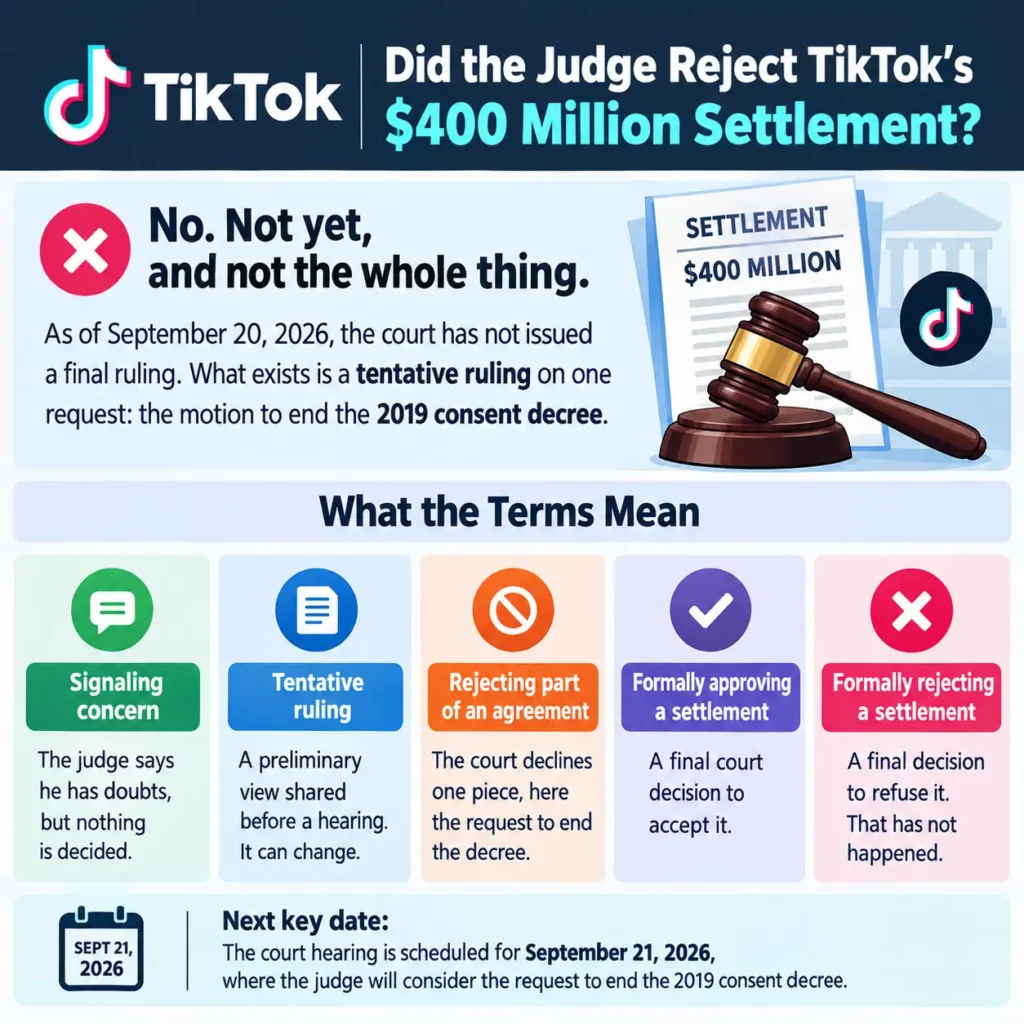
The terms are easy to mix up:
- Signaling concern: the judge says he has doubts, but nothing is decided.
- Tentative ruling: a preliminary view shared before a hearing. It can change.
- Rejecting part of an agreement: the court declines one piece, here the request to end the decree.
- Formally approving a settlement: a final court decision to accept it.
- Formally rejecting a settlement: a final decision to refuse it. That has not happened.
What Happens at September 21 Hearing?
Judge Wu scheduled the hearing for Monday, September 21, 2026, in Los Angeles. One report puts it at 8:30 a.m. local time. Its purpose is to hear the parties on the request to end the 2019 consent decree.
Tentative rulings are the court’s early view. After hearing arguments, the judge can adopt the ruling, change it, or ask for more information. PPC Land’s summary says a denial would be “without prejudice,” which means the government could file again with more detail.
What remains unclear? Whether the parties will share more about the settlement terms. Whether the $100 million is still owed if the decree stays. And how TikTok shop and the Justice Department will respond. Neither answered Reuters’ requests for comment on Saturday.
What Could This Mean for TikTok Users?
For most people scrolling the app, nothing changes today. None of the reporting we reviewed says the ruling will change how TikTok works for ordinary users.
The case is about children’s privacy and compliance. If the 2019 decree stays, its reporting, record-keeping and oversight duties would continue. That is about how the company proves it follows the law, not about new app features.
Parents may still want to review privacy and parental-control settings on a young person’s account. The Justice Department says age-related protections have improved. Whether that justifies ending the decree is what the court is weighing.
What TikTok Has Changed Since the Case Began
The Justice Department says TikTok has changed significantly since the 2024 complaint. In its August 21 statement, the department pointed to changes in ownership, management, compliance functions and privacy practices. It also said the company has strengthened safeguards for younger users, improved age-related controls and enhanced parental oversight. Those are the government’s claims about TikTok’s changes, not court findings. U.S. Department of Justice
On ownership, Reuters reports that ByteDance agreed in January to set up a majority American-owned joint venture. Fox stations name Oracle, Silver Lake and MGX as partners in managing the new U.S. entity.
On age controls, PPC Land’s summary of a TikTok employee’s declaration says new users must enter a birth date and that a sign-in route that skipped the age check was removed. The judge, according to that summary, said having tools is not proof of compliance.
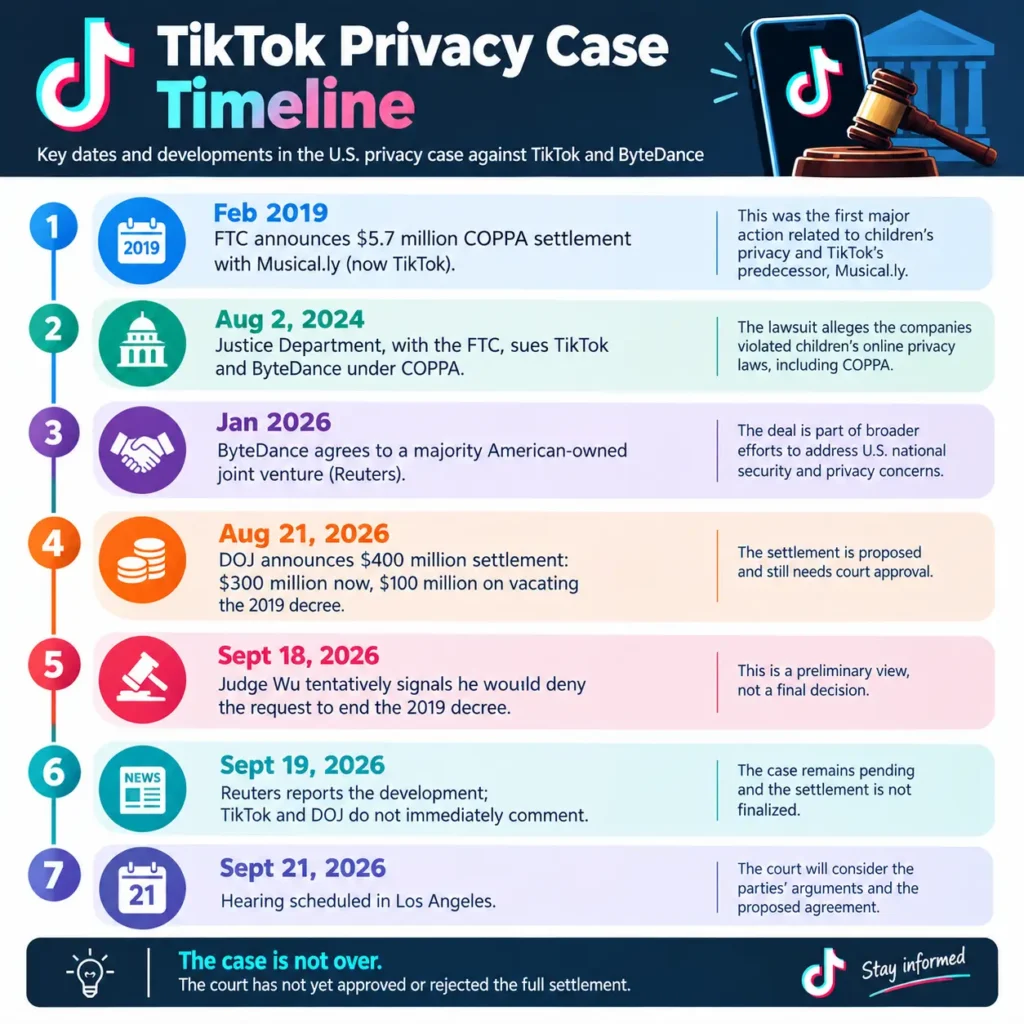
TikTok Privacy Case Timeline
| Date | Event |
|---|---|
| Feb 2019 | FTC announces $5.7 million COPPA settlement with Musical.ly (now TikTok) |
| Aug 2, 2024 | Justice Department, with the FTC, sues TikTok and ByteDance under COPPA |
| Jan 2026 | ByteDance agrees to a majority American-owned joint venture (Reuters) |
| Aug 21, 2026 | DOJ announces TikTok $400 million settlement: $300 million now, $100 million on vacating the 2019 decree |
| Sept 18, 2026 | Judge Wu tentatively signals he would deny the request to end the 2019 decree |
| Sept 19, 2026 | Reuters reports the development; TikTok and DOJ do not immediately comment |
| Sept 21, 2026 | Hearing scheduled in Los Angeles |
What Happens Next for TikTok and ByteDance?
After Monday’s hearing, the judge may issue a final decision on the request to end the consent decree, or he may take more time. If he denies it, the parties could go back to the court with more information, or they could rework the deal. If he grants it, the $100 million condition would be met, based on how the DOJ described the deal.
The settlement terms have not been made public in the reporting we reviewed. That is why the details may matter at the hearing. Watch for the court’s order, any new Justice Department filing and any statement from TikTok. This article does not predict the outcome.
Frequently Asked Questions
Why is TikTok facing a $400 million settlement?
The Justice Department sued TikTok and ByteDance in 2024, alleging violations of the children’s privacy law COPPA. The companies agreed in August 2026 to settle. The claims are allegations only.
Did TikTok already agree to pay $400 million?
TikTok agreed to a TikTok $400 million settlement in August. The DOJ says $300 million is payable immediately and $100 million only if a court vacates the 2019 decree. The reporting we reviewed does not clearly confirm what has been paid.
Did the judge reject the TikTok settlement?
Not formally. Judge Wu tentatively signaled he would reject one part: the request to end the 2019 consent decree. No final ruling has been issued.
What is COPPA?
The Children’s Online Privacy Protection Act. It requires parental notice and consent before online services collect personal information from children under 13.
What is the TikTok 2019 consent decree?
A court order from the FTC’s 2019 case against Musical.ly, now TikTok. It requires COPPA compliance and includes reporting and record-keeping duties running through 2029.
When is the next TikTok privacy settlement hearing?
Monday, September 21, 2026, in federal court in Los Angeles.
Does this case affect normal TikTok users?
No immediate change has been reported. The case concerns children’s privacy compliance and oversight, not new features for ordinary users.
Will TikTok have to pay the full $400 million?
That is not yet clear. The DOJ tied $100 million to ending the 2019 decree, which the judge tentatively signaled he would not grant. Final settlement terms have not been made public in the reports we reviewed.
Final Takeaway
A federal judge has signaled he is inclined to refuse one part of the TikTok $400 million settlement: the request to end a 2019 children’s privacy order. That leaves $100 million of the deal in doubt. The court has not rejected the settlement, and nothing is final.
The September 21 hearing is the next test. Watch for the judge’s decision, any new details about the settlement and any response from TikTok or the Justice Department. Remember, the underlying claims remain allegations, with no determination of liability.