TikTok Gravity Hoax 2026 – Earth Going Gravityless on 12 Aug
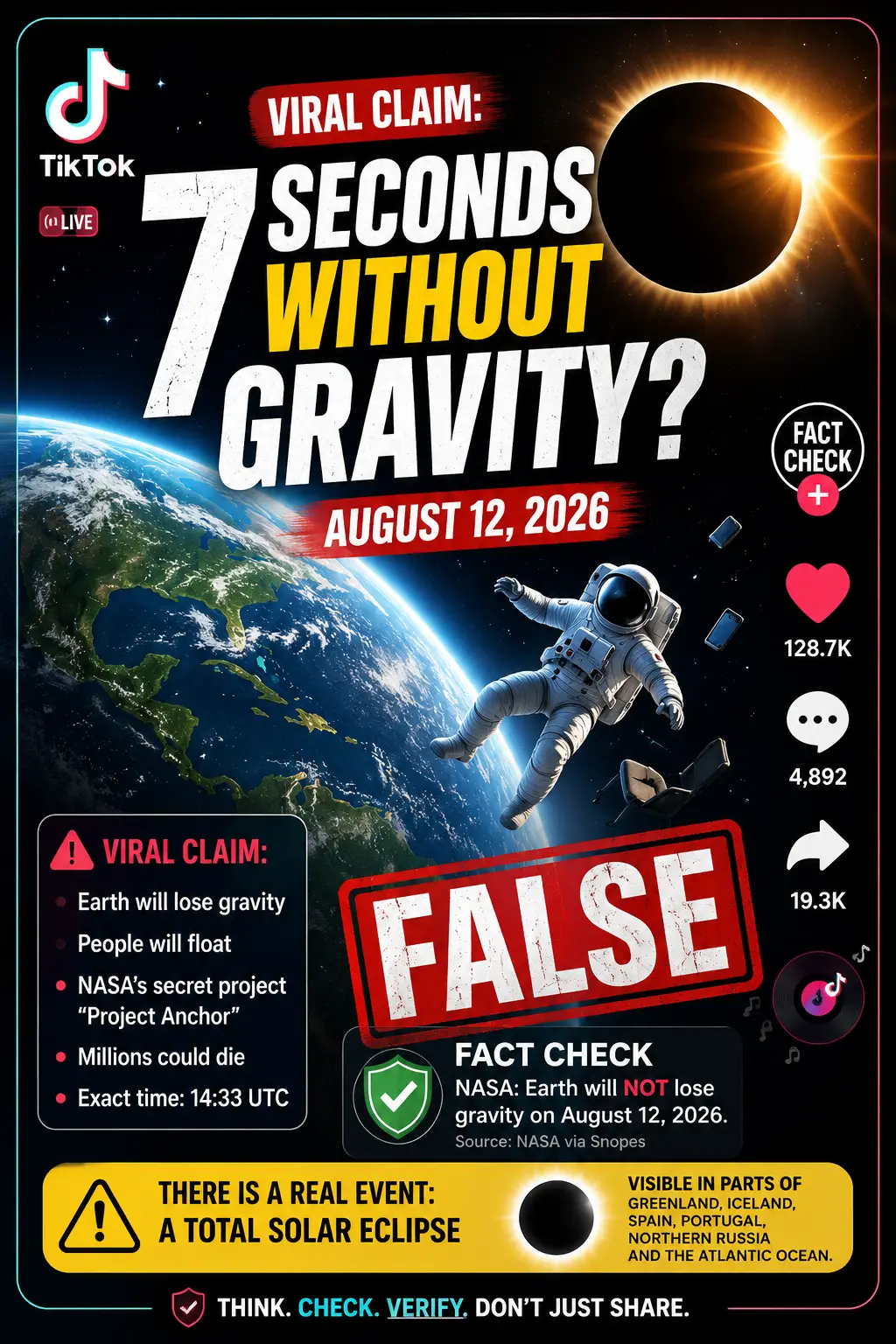
If you have seen TikTok videos or social media posts claiming that Earth will lose gravity for seven seconds on August 12, 2026, there is no need to panic.
The claim is false. NASA has explicitly said that Earth will not lose gravity on August 12, 2026. The viral story appears to mix a real astronomical even, a total solar eclipse, with a completely unsupported claim about a supposed “Project Anchor” and a temporary worldwide loss of gravity.
There really is a major astronomical event on August 12: NASA says a total solar eclipse will cross Greenland, Iceland, northern Russia, the Atlantic Ocean, Spain and a small part of Portugal. But an eclipse does not switch Earth’s gravity off.
So, what is the TikTok gravity hoax, where did it come from, and why are people talking about “seven seconds,” “Project Anchor” and NASA? This guide from the best story viewer website will separate the viral story from the facts.
Quick Answer: Will Earth Lose Gravity for 7 Seconds?
No, Earth will not lose gravity for seven seconds on August 12, 2026.
NASA told Snopes that Earth’s gravity is determined by Earth’s mass and that a total solar eclipse has no unusual effect on Earth’s gravity. NASA also explained that the gravitational effects of the Sun and Moon are understood and predictable.
There is also no credible evidence that NASA has a secret “Project Anchor” designed to prepare for a seven gravity blackout. Searches reported by Snopes found no reputable evidence of such a leaked NASA project.
| Viral claim | What the evidence shows |
|---|---|
| Earth will lose gravity | False |
| Gravity will disappear for 7 seconds | No evidence |
| NASA knows about the event | False |
| NASA created “Project Anchor” | No credible evidence |
| The event will happen at 14:33 UTC | Unsupported |
| 40 million people will die | Unsupported viral claim |
| The August 12 eclipse will cause gravity loss | False |
| There is a real August 12 eclipse | Yes |
What Is the TikTok Gravity Hoax?
The TikTok gravity hoax is a viral internet claim saying that Earth’s gravity will temporarily disappear on August 12, 2026. According to posts that circulated online, the event would supposedly last around seven seconds.
Some versions of the story added much more dramatic details:
- People would float into the air.
- Cars and other objects would rise.
- Buildings and infrastructure would be damaged.
- Millions of people would die.
- NASA supposedly knew about the event in advance.
- A secret NASA program called Project Anchor was supposedly created to prepare for it.
- The event was supposedly scheduled for a precise time: 14:33 UTC.
- A supposed $89 billion budget was attached to the alleged project.
These details are part of the viral claim, not established scientific facts.
A fact check published in January 2026 traced examples of the rumor across Instagram, Bluesky, Facebook, Reddit, Threads, TikTok and X. The fact check rated the claim false and reported NASA’s direct response.
Did NASA Really Say Earth Will Lose Gravity?
No, this is one of the most important parts of the story because many versions of the rumor try to make the claim look legitimate by mentioning NASA. A NASA spokesperson told Snopes:
“The Earth will not lose gravity on Aug. 12, 2026.”
NASA explained that Earth’s total gravitational force is determined by its mass. For Earth to lose its gravity in the way described by the rumor, the mass of Earth’s system would have to change.
That is very different from a viral TikTok saying gravity will simply switch off for seven seconds.
NASA’s position vs. the viral claim
Viral post:
“NASA knows Earth’s gravity will disappear.”
Verified information:
NASA says Earth will not lose gravity on August 12, 2026.
This distinction matters. A TikTok video can contain a convincing looking NASA logo, document, countdown or scientific wording without actually being an official NASA announcement.
What Is “Project Anchor”?
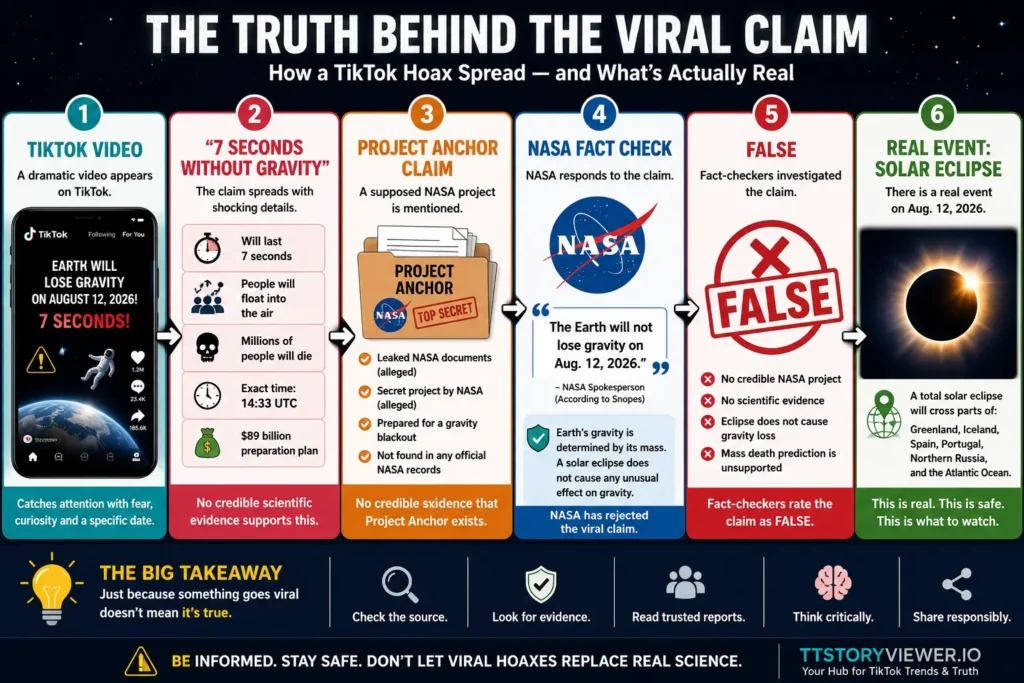
Project Anchor is the supposed secret NASA project mentioned in the viral gravity story.
According to the rumor, NASA allegedly created the project after a secret document leaked in November 2024. The story claimed that Project Anchor was designed to prepare Earth for a temporary gravitational anomaly. But there is a major problem:
There is no credible evidence that NASA created such a project. The January fact check reported that searches across major search engines and social media platforms found no reputable evidence of a leaked NASA “Project Anchor” document from November 2024.
There is currently a website using the name Project Anchor 2026 that presents the seven second event as a supposed scheduled anomaly. However, the website itself describes the project as “COMPLETELY UNOFFICIAL.”
That is important. A website existing on the internet does not make the scientific claim behind it real.
Where Did the 7 Second Gravity Rumor Come From?
The earliest documented example identified in the fact checking research came from an Instagram account called @mr_danya_of. According to the January investigation, a post appeared on December 31, 2025, claiming:
- Earth would lose gravity on August 12, 2026.
- The event would last seven seconds.
- NASA supposedly knew about it.
- Project Anchor supposedly existed.
The account later became unavailable. From there, versions of the claim appeared across multiple social platforms. That includes:
Instagram → Facebook → TikTok → Reddit → X → Threads → other social platforms
This is a useful lesson about viral misinformation. A claim can be repeated thousands of times without becoming more accurate.
Why Is the Gravity Claim Going Viral on TikTok?
TikTok is particularly good at spreading content that creates an immediate emotional reaction. Think about the wording of the rumor:
“Earth will lose gravity for 7 seconds.”
That sentence immediately creates curiosity. Then the story adds:
NASA + secret project + exact date + exact time + billions of dollars + millions of deaths.
Each additional detail makes the story feel more researched. But a detailed story isn’t necessarily a true story.
Why this type of claim spreads
Several elements make the rumor attractive:
- It has an exact date.
- It has an exact time.
- It uses the name NASA.
- It includes a mysterious project name.
- It includes a huge budget.
- It predicts a dramatic event.
- It gives people something to fear or debate.
- It is easy to explain in a short video.
- Viewers can easily share it with friends.
This is why searches such as “TikTok gravity,” “TikTok gravity hoax,” “Project Anchor TikTok” and “August 12 gravity” can appear around the same story. The important point is that virality is not evidence.
Is There Actually a Solar Eclipse on August 12, 2026?
Yes, this is where the rumor becomes especially interesting. NASA confirms that a total solar eclipse occurs on August 12, 2026. The path of totality crosses areas including Greenland, Iceland, northern Russia, the Atlantic Ocean, Spain and a small part of Portugal. Other parts of the Northern Hemisphere will see a partial eclipse.
NASA says totality will last less than two and a half minutes even near the center of the eclipse path. So there is a real event happening on August 12.
Real event which are not equal to viral claim
| August 12 event | Status |
|---|---|
| Total solar eclipse | Real |
| Moon passes between Earth and Sun | Real |
| Temporary darkness in the path of totality | Real |
| Earth loses gravity | False |
| Seven-second gravity blackout | No evidence |
| Project Anchor | No credible NASA evidence |
| Millions of deaths from gravity loss | Unsupported |
This is probably one of the biggest reasons the rumor sounds believable. The viral story attaches itself to a real astronomical event.
Does a Solar Eclipse Affect Earth’s Gravity?
A solar eclipse does not make Earth’s gravity disappear.
During an eclipse, the Moon passes between Earth and the Sun and blocks some or all of the Sun’s light from reaching parts of Earth. NASA explains that the gravitational attraction of the Sun and Moon is already understood and predictable. A solar eclipse does not suddenly remove Earth’s gravitational force.
The Sun and Moon do exert gravitational effects on Earth. Those effects contribute to phenomena such as tides. But that is completely different from Earth suddenly losing its own gravity.
A simple way to understand it
Imagine your house. Your house has weight because of the material that makes it up. If someone puts a curtain over a window, the curtain doesn’t make the house lose its weight.
A solar eclipse is about light being blocked. It does not remove Earth’s mass. And Earth’s mass is central to its gravity.
Why Can’t Earth Simply “Turn Off” Gravity?
Gravity isn’t like a light switch. You cannot simply press a button and turn Earth’s gravity off for seven seconds. Earth’s gravitational force comes from its mass.
NASA specifically explained that Earth’s total gravitational force is determined by the mass of the Earth system. This is why the claim doesn’t fit basic physics.
The viral story describes gravity as if it were a temporary service outage:
Gravity ON → Gravity OFF → 7 seconds → Gravity ON
That’s not how gravity works.
What About Black Holes and Gravitational Waves?
Some versions of the rumor attempt to explain the supposed gravity loss by claiming that gravitational waves from colliding black holes will somehow cancel Earth’s gravity.
That sounds scientific, but it doesn’t make the underlying claim true. Gravitational waves are real. Black hole mergers are real.
But that does not mean a predicted collision can switch off Earth’s gravity. The viral story combines real scientific terms with an unsupported conclusion.
That is a common pattern in science misinformation: Real scientific concept + fictional connection = convincing looking false claim.
What Would Happen If Gravity Actually Disappeared?
This section is a hypothetical physics thought experiment, not a prediction for August 12. If Earth’s gravitational attraction somehow disappeared, the consequences would be serious.
But the exact outcome would depend on what “gravity disappearing” means physically and what other forces remained.
For example:
- Objects would no longer be held to Earth’s surface by Earth’s gravitational attraction.
- The atmosphere would no longer behave normally.
- Oceans and other bodies of water would be affected.
- People and objects could move away from the surface depending on their existing motion and other forces.
- Satellites and orbital systems would be affected.
- Earth’s relationship with the Moon and other bodies would become radically different.
However, it would be misleading to repeat the viral claim that everyone would automatically shoot 15–20 meters into the air and that exactly 40 million people would die. Those numbers come from the rumor, not from a credible scientific prediction.
TikTok Gravity Claim vs Reality
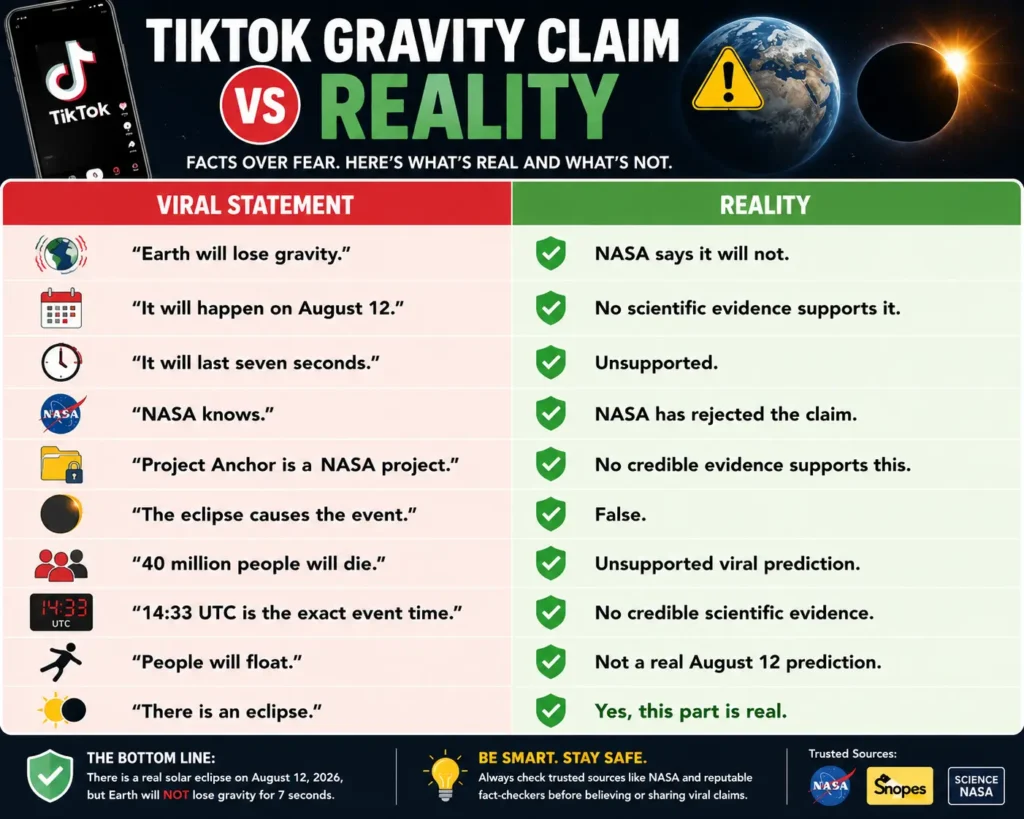
Here’s the simplest way to understand the whole story:
| Viral statement | Reality |
|---|---|
| “Earth will lose gravity.” | NASA says it will not. |
| “It will happen on August 12.” | No scientific evidence supports it. |
| “It will last seven seconds.” | Unsupported. |
| “NASA knows.” | NASA has rejected the claim. |
| “Project Anchor is a NASA project.” | No credible evidence supports this. |
| “The eclipse causes the event.” | False. |
| “40 million people will die.” | Unsupported viral prediction. |
| “14:33 UTC is the exact event time.” | No credible scientific evidence. |
| “People will float.” | Not a real August 12 prediction. |
| “There is an eclipse.” | Yes, this part is real. |
What Actually Happens on August 12, 2026?
The real headline is much more interesting than the TikTok Gravity hoax. NASA confirms a total solar eclipse on August 12, 2026. The eclipse will be visible as total from parts of:
- Greenland
- Iceland
- northern Russia
- the Atlantic Ocean
- Spain
- a small part of Portugal
A much larger area will experience a partial solar eclipse. NASA also notes that the eclipse will create different viewing opportunities depending on location, with some areas seeing the event around sunset. So if you’re interested in August 12, watch the real astronomical event rather than worrying about a fictional gravity blackout.
And if you are watching the eclipse, follow proper solar viewing safety guidance. NASA says that people viewing a partial eclipse directly should use safe solar viewing glasses or another safe solar viewer.
What Are People Searching About the TikTok Gravity Rumor?
The wording varies, but most searches have the same basic question: “Is this TikTok claim actually true?”
Common searches include:
- Earth lose gravity 7 seconds
- Will Earth lose gravity for 7 seconds?
- Earth lose gravity August 12
- August 12 gravity
- August 12 2026 gravity
- Will Earth lose gravity on August 12?
- Is the August 12 gravity claim real?
- Is Earth losing gravity?
- No gravity August 12
- Zero gravity August 12
- Gravity blackout
- Earth gravity hoax
- August 12 gravity hoax
- TikTok gravity
- TikTok gravity hoax
- TikTok gravity rumor
- TikTok Project Anchor
- Project Anchor TikTok
- Is Project Anchor real?
- Is NASA Project Anchor real?
- Did NASA predict no gravity?
- Why is gravity trending on TikTok?
- Why is TikTok saying Earth will lose gravity?
- What happens if gravity disappears?
- Blocking people on TikTok
- Taylor wift song removed
The search intent behind nearly all of them is the same: People want to know whether the viral claim is real.
That is why a good fact check should answer the question immediately instead of hiding the verdict halfway through the article.
How to Check Viral TikTok Science Claims
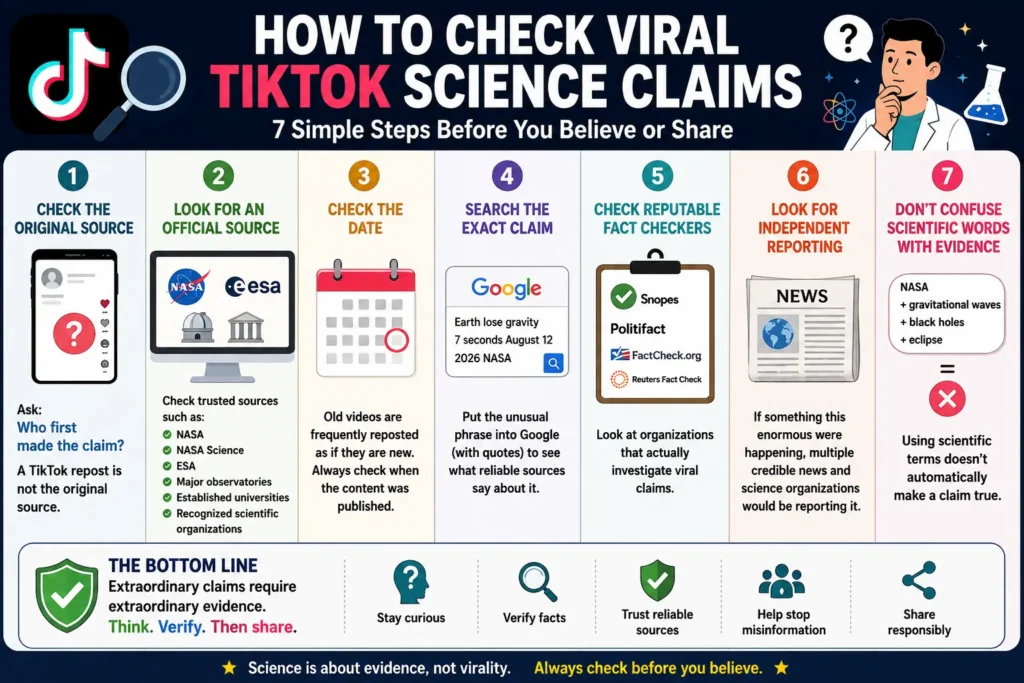
The next time you see a dramatic scientific claim on TikTok, don’t immediately share it. Use this simple process.
1. Check the original source
Ask:
Who first made the claim?
A TikTok repost is not the original source.
2. Look for an official source
For space related claims, check sources such as:
- NASA
- NASA Science
- ESA
- major observatories
- established universities
- recognized scientific organizations
3. Check the date
Old videos are frequently reposted as if they are new.
4. Search the exact claim
Put the unusual phrase into Google.
For example:
“Earth lose gravity 7 seconds August 12 2026 NASA”
5. Check reputable fact checkers
Look at organizations that actually investigate viral claims.
6. Look for independent reporting
If something truly this enormous were happening, you would expect multiple credible scientific and news organizations to be discussing it.
7. Don’t confuse scientific words with scientific evidence
A post mentioning:
NASA + gravitational waves + black holes + eclipse
doesn’t automatically become scientific.
Why Exact Dates Make Viral Hoaxes So Powerful
There’s something psychologically powerful about an exact date. Compare these two claims:
“Something strange may happen someday.”
versus:
“Earth will lose gravity on August 12, 2026, at 14:33 UTC.”
The second sounds much more precise.People naturally ask:
“How could someone know the exact date and time if it wasn’t real?”
But precision isn’t proof. In fact, an exact date can make misinformation more shareable because it gives people a reason to keep checking.
The Project Anchor rumor uses exactly this technique:
August 12 → 14:33 UTC → 7 seconds → NASA → $89 billion → millions of deaths
The more specific the story becomes, the more real it can feel. But the evidence still matters more than the detail.
Our Take on the TikTok Gravity Claim
At TTStoryViewer.io, our view is simple:
This is a good example of why viral TikTok content should be checked before it is believed or shared.
The story has almost everything needed to become viral:
- A mysterious project
- NASA
- a precise date
- a precise time
- an eclipse
- black holes
- gravity
- a huge financial figure
- frightening predictions
- an easy to share explanation
But when you strip away the dramatic details, the evidence doesn’t support the central claim. NASA says Earth will not lose gravity on August 12, 2026. NASA also confirms that the real event on that date is a total solar eclipse.
Our biggest takeaway is therefore not just:
“The TikTok is false.”
It is: Don’t let a viral video become your source of truth simply because it looks convincing.
Check the original source. Check the date. Check the science. And, especially with dramatic claims involving NASA or major global events, look for primary evidence.
Frequently Asked Questions
Q1: Will Earth lose gravity for 7 seconds on August 12, 2026?
No, NASA has said that Earth will not lose gravity on August 12, 2026.
Q2: Is the August 12 gravity claim real?
No credible scientific evidence supports the claim that Earth’s gravity will disappear on August 12.
Q3: What is Project Anchor?
“Project Anchor” is the name used in the viral story about the alleged gravity event. There is no credible evidence that it is a NASA program connected to a gravity blackout.
Q4: Did NASA predict the gravity blackout?
No, NASA explicitly rejected the claim that Earth would lose gravity on August 12, 2026.
Q5: Will people float on August 12?
No, there is no scientific basis for expecting people to float because Earth’s gravity will disappear.
Q6: Is there a solar eclipse on August 12, 2026?
Yes, NASA confirms a total solar eclipse on August 12, 2026.
Q7: Does a solar eclipse turn off gravity?
No, NASA says a total solar eclipse has no unusual impact on Earth’s gravity.
Q8: What time is the supposed gravity blackout?
The viral story commonly gives 14:33 UTC, but there is no credible scientific evidence that a gravity blackout will happen at that time.
Q9: the claims about 40 million deaths real?
No, the prediction of tens of millions of deaths is part of the viral story and has not been supported by credible scientific evidence.
Q10: Why is the gravity story trending on TikTok?
The story combines an exact date, NASA, an alleged secret project, an eclipse and dramatic consequences. Those elements make the claim easy to turn into attention grabbing social media content.
Final Verdict: TikTok Gravity Hoax
No, Earth will not lose gravity for seven seconds on August 12, 2026.
NASA has directly rejected the claim. There is no credible evidence for a secret NASA Project Anchor, no evidence of a scheduled global gravity blackout, and no scientific basis for the claim that an eclipse will cause Earth’s gravity to disappear.
What is real is the August 12, 2026 total solar eclipse. So if you see a TikTok saying:
“NASA knows. Earth will lose gravity for seven seconds.”
don’t worry. Check the source before you share it. The real August 12 event is an eclipse, not a gravity blackout.